What is tester perfume? It's a fragrance bottle intended for customers to try, usually at a store counter, rather than a special watered-down version of the scent. Testers sometimes make their way to resale and discount sellers, often with plain packaging or no cap. If the bottle is authentic and contains the same fragrance and concentration as the retail version, the juice is generally the same. The catch is that condition, packaging, and seller reliability matter.
What is tester perfume sold without the fancy box?
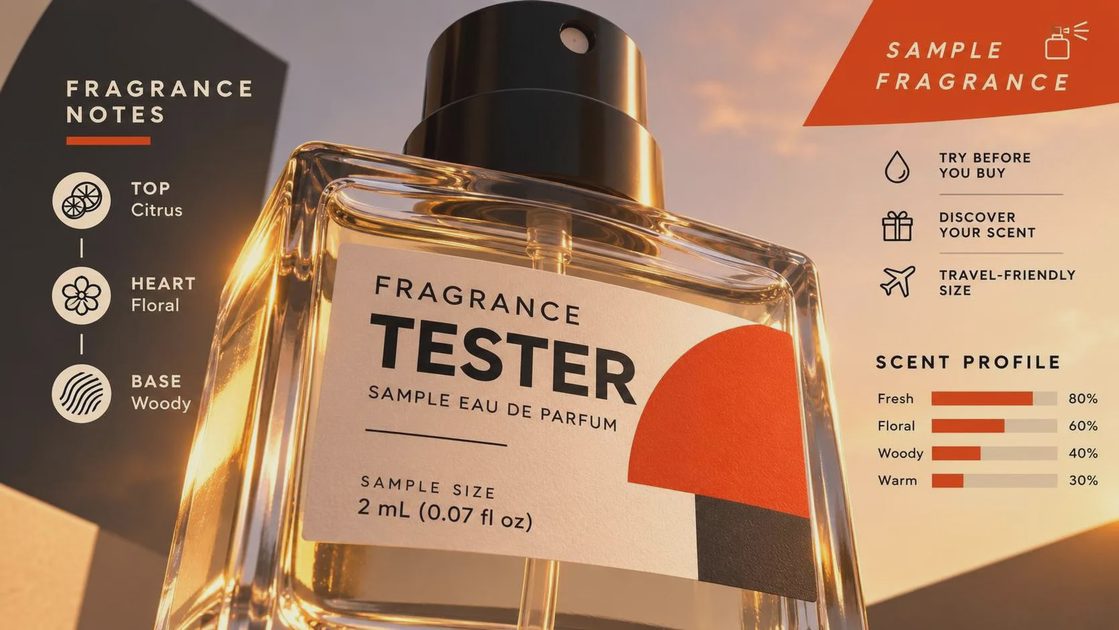
A brand may supply a tester so shoppers can spray a fragrance before committing to a full bottle. Some testers look almost identical to the retail product. Others arrive in a plain carton, have a label identifying them as testers, or lack a decorative cap. Packaging varies by brand and fragrance, so don't assume every tester will look the same.
A tester is not necessarily a sample. A sample is typically a small vial meant for a few wears; a tester can be a full-size bottle. Nor is it automatically a decant, which is fragrance transferred from a larger bottle into a smaller container. A decant's condition depends partly on how it was transferred and stored.
The distinction matters if you're shopping for someone else. A plain box and missing cap might be perfectly acceptable on your own shelf but feel a little underdressed as a gift. Ask whether the listing includes the original cap, box, and protective packaging before ordering. Don't rely on a stock photo to answer those questions.
A bottle advertised as a tester may be new and unused, or it may have been opened or sprayed. The word alone doesn't tell you which. Look for the seller's condition description, and ask about the fill level if it's unclear. A small air gap is normal in many bottles, but an unusually low fill level deserves an explanation.
Does a tester smell the same as the regular bottle?
An authentic tester of the same fragrance and concentration is generally meant to smell like its retail counterpart. Brands want shoppers to try the actual scent, not a different recipe designed to lure them in. I would be skeptical of a blanket claim that testers are always stronger, weaker, or longer-lasting.
That doesn't mean two bottles will always smell identical to your nose. Fragrances can be reformulated over time, and age, storage, and even the surface you're spraying can affect your impression. A bottle kept in heat or direct sunlight may not smell as it did when fresh. Skin can also bring out a different side of a fragrance than a paper strip does.
Check the entire name and concentration before comparing. An eau de parfum and an eau de toilette from the same fragrance family can have different compositions; the label isn't just telling you how strong the perfume is. Flankers, those variations with an extra word in the name, can smell different too. Think of them as cousins, not identical jars of the same sauce.
If a scent smells sharply sour, unusually flat, or otherwise off, that can be a reason to contact the seller. It isn't proof of a counterfeit on its own. Note the condition, keep the packaging, and follow the seller's return process rather than trying to diagnose the bottle from one spray.
Why are tester bottles sometimes cheaper?
Less elaborate packaging can reduce presentation costs, and some sellers price testers below boxed retail bottles. But there is no guaranteed tester discount. Prices depend on the seller, bottle size, availability, and the specific fragrance. A sale on a regular bottle can beat a tester listing, especially once shipping enters the picture.
Compare the total price per ounce, not just the number in large type. For example, a $60 bottle containing 3 ounces works out to $20 per ounce before shipping and tax. A $45 bottle containing 1.7 ounces costs about $26.47 per ounce. The smaller bottle costs less upfront, but it isn't the cheaper way to buy that volume.
There's another wrinkle: a bargain is only a bargain if you actually want the fragrance. A full-size tester of something you've never worn is still a blind buy. I would rather pay for a small sample first than own a discounted bottle that spends its life hiding behind the bathroom towels.
How to shop without getting burned
Start with the seller, not the discount. A retailer authorized by the fragrance brand is the simplest route if authenticity is your priority. Other legitimate sellers may offer testers, but verify their contact information, condition descriptions, and return policy. An unusually low price isn't proof of a fake, but it is a reason to slow down and ask more questions.
Read the exact listing for size, concentration, fill level, and whether the bottle comes with a cap or box. Confirm whether the photo shows the actual item or is illustrative. If the seller describes it as used, ask how much remains and whether the sprayer works. A missing cap doesn't make the fragrance fake, but you'll want to know about it before it arrives.
Batch codes and packaging details can be useful clues, not guarantees. Codes can be copied, and legitimate packaging can change. Online photos of another bottle may also show a different production run or market. If you're unsure, ask the brand or an authorized retailer about the particular presentation rather than treating one online comparison as a definitive authentication test.
Before paying, check who covers return shipping and whether opened fragrances can be returned. Keep screenshots of the listing and photograph any damage or leakage when the package arrives. If the bottle was misrepresented, that documentation gives you something concrete to share with the seller or payment provider.
Finally, store your purchase away from heat and direct light, with the sprayer protected from accidental presses. A cap is handy, but a cool, dark shelf matters more than a beautiful box. For a scent you already enjoy, a clearly described tester from a seller you trust can be a sensible way to spend less. For a new-to-you fragrance, start small and give it a full day on skin first.
No comments yet — be the first to share a thought.