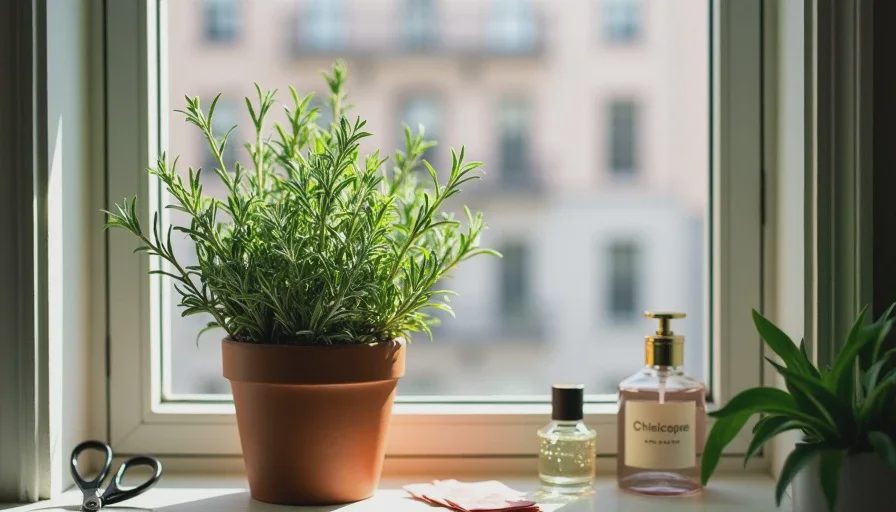
I have been writing about perfume notes explained in plain language for years, but it took a $4 rosemary plant from the farmer's market to teach me something no fragrance pyramid ever did. The plant sat on my kitchen windowsill next to the thyme and basil, and over the course of a single growing season, it rewired how I smelled everything. Not because rosemary is complicated. Because it is real. When you grow a plant, you experience it in three dimensions — you touch it, you bruise the leaves, you cook with it, you watch it change with the light. That experience is something no notes pyramid can replicate, and it changed how I read rosemary in fragrance forever.
The Plant That Started It All
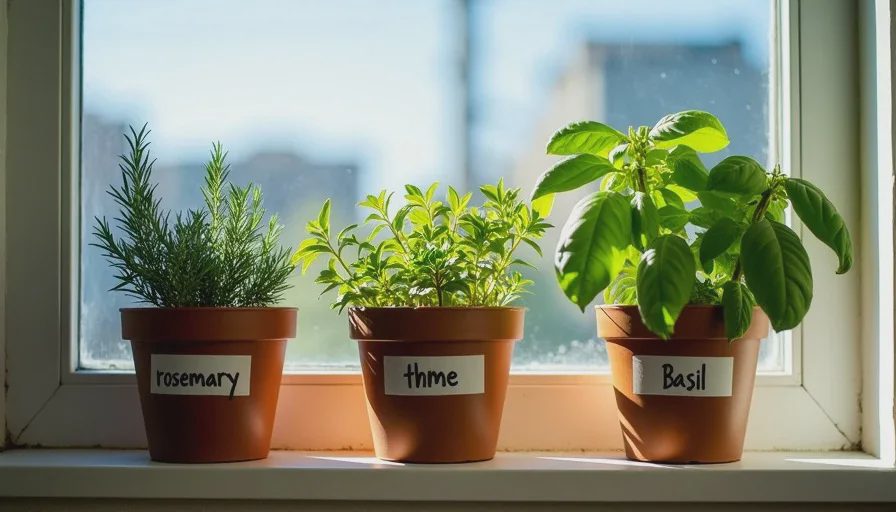
I bought the rosemary on a Saturday in April. I was at the Green City Market in Lincoln Park, killing time before meeting a friend, and a table of herb seedlings caught my eye. I grabbed rosemary, thyme, and basil — three plants, twelve dollars total. I did not have a plan. I just wanted something alive on the windowsill.
What Growing Rosemary Actually Teaches You
Here is the thing nobody tells you about rosemary: it does not smell the same all the time. The scent shifts depending on what you do to it and what the plant is doing.
Undisturbed plant: A faint, clean, camphoraceous hum. You have to lean in close.
Brushed against: Stronger, greener, with a sharp edge that almost tingles.
Leaves crushed between fingers: Intensely aromatic, resinous, slightly piney, with a warmth that lingers on your skin.
After rain: The soil and the plant together create something earthy and green that no bottle captures.
This was my first lesson. Rosemary in a fragrance is not one scent. It is a spectrum, and the note pyramid tells you none of this. It just says "rosemary" as if that explains anything.
The Skin Connection
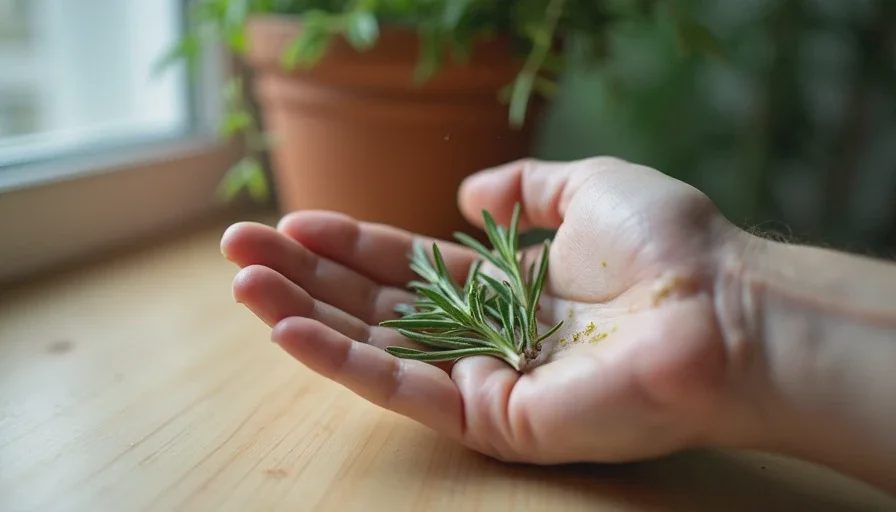
I started noticing something else. When I crushed rosemary leaves and rubbed them on my wrist — not for any scientific reason, just because I was cooking and curious — the scent lasted longer than I expected. And it smelled different from the essential oil I had in my fragrance kit. The fresh plant was greener, more volatile, and it had a quality I can only describe as "alive."
That word matters. When perfume notes explained in reviews talk about rosemary, they usually mean the distilled essential oil, which is concentrated and somewhat one-dimensional compared to the living plant. The oil is useful and beautiful, but it is a translation, not the original text. Growing the plant taught me the difference.
How It Changed My Fragrance Testing
Once I had the living plant as a reference point, my testing changed. I started keeping a sprig of rosemary on my testing table. Before I evaluated any fragrance that listed rosemary as a note, I would crush a leaf, smell it, then smell the fragrance. The comparison was eye-opening.
What I Noticed
Some fragrances captured the green, bright, living quality of fresh rosemary. Others smelled like the dried herb you find in a spice jar — dusty, muted, flat. And a few smelled like neither. They smelled like an abstract interpretation of rosemary, something a perfumer built from other materials to evoke the idea without using the real thing.
Rosemary Impression in Fragrance | What It Means | How Often I Encounter It |
|---|---|---|
Fresh, green, bruised-leaf quality | Likely uses real rosemary oil or a high-quality reconstitution | Common in niche, rare in designer |
Dried, dusty, culinary | Often a lower-grade oil or a synthetic approximation | Common in mass-market fragrances |
Abstract, herbal but unrecognizable | A fantasy note — the perfumer is evoking, not replicating | Common in artistic compositions |
This table is not scientific. It is a pattern I noticed across roughly thirty fragrances that list rosemary as a note. But the pattern was consistent enough that I started trusting my living plant as a calibration tool.
The Nate Test
Nate got involved by accident. He was making breakfast one morning, grabbed rosemary from the windowsill for eggs, and said, "This smells like your perfume stuff." I asked which one. He named a fragrance I had been testing that week. I checked the notes — rosemary was in the heart. He had made the connection without any prompting, just by handling the real plant and then catching a trace of it on me.
That moment crystallized something for me. When perfume notes explained well, they should connect to something you already know. If you have ever cooked with rosemary, you already have a library of scent memories that a fragrance can draw on. The note is not foreign. It is familiar, just renamed.
Why This Matters Beyond Rosemary
The rosemary experiment led me to start growing thyme and basil seriously, and each plant taught me the same lesson in a different key. Thyme is sharper, almost medicinal when you crush it. Basil is sweeter and more volatile — it disappears from your fingers in minutes. Each living plant became a reference that sharpened my ability to pick that note out of a complex fragrance.
Tried it. Lived with it. Then I'll tell you if it's worth it. — Growing herbs will not make you a perfumer. But it will make you a better smeller. And being a better smeller is the single most useful skill in fragrance, because everything else — pyramids, reviews, recommendations — is just someone else's description of a scent you could experience yourself.
The Windowsill as a Testing Lab
If you want to try this yourself, you do not need a garden. You need a sunny windowsill, three small pots, and a willingness to touch the plants. Here is what I recommend:
Buy one herb plant — rosemary, thyme, or basil. Start with one.
Keep it on your windowsill where you will see it daily.
Before testing any fragrance that lists that herb as a note, crush a leaf and smell it first.
Compare the living scent to the fragrance on paper, then on skin.
Note the differences. They will be more instructive than any review.
The point is not to become a botanist. The point is to have a real, three-dimensional reference for a note that otherwise exists only as a word on a pyramid. When perfume notes explained in reviews say "rosemary," you will know exactly what they mean — not because you read a definition, but because you grew it, touched it, and cooked with it. That knowledge lives in your nose in a way no article can put there.




No comments yet — be the first to share a thought.